
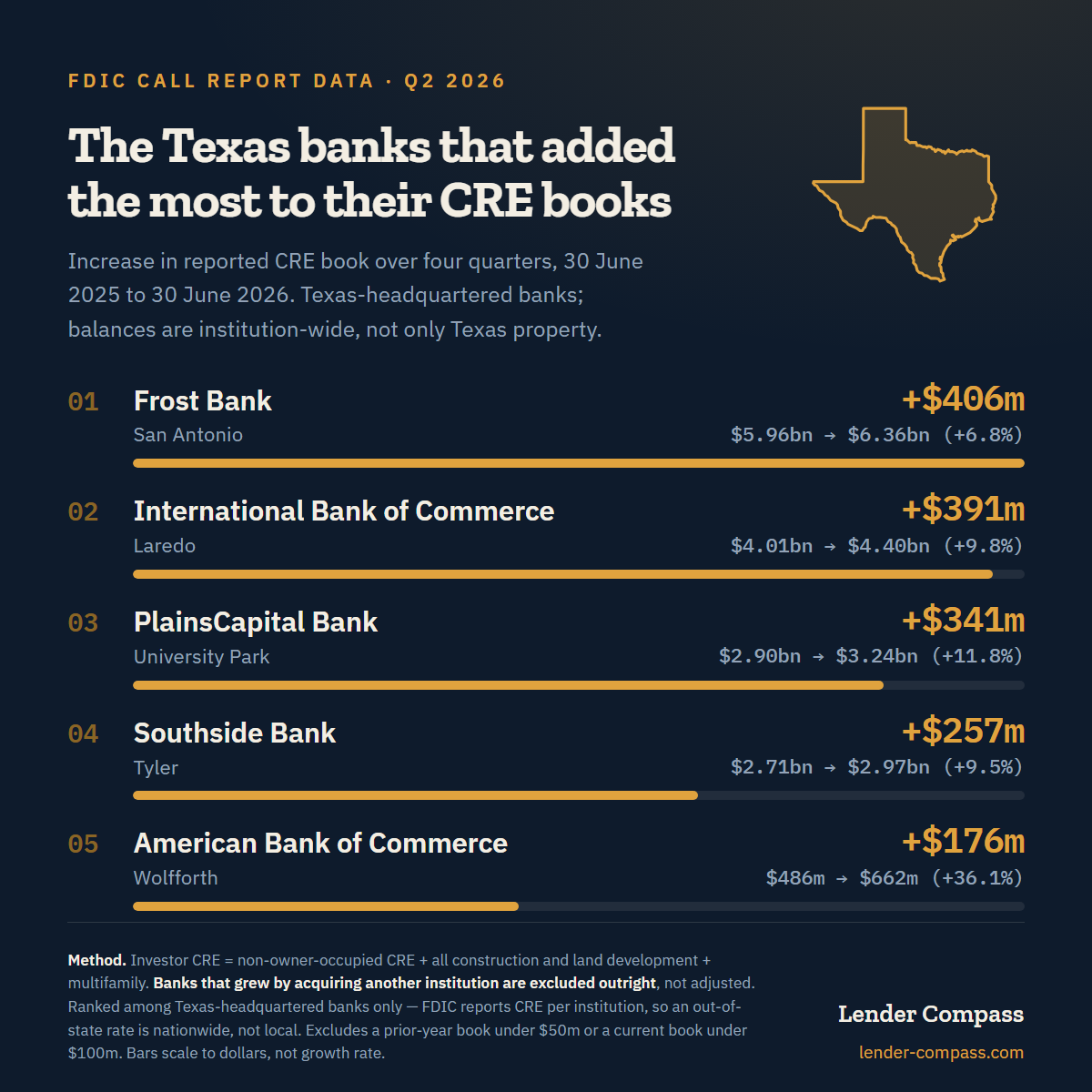
| Institution | Headquarters | CRE book, Jun 2025 | CRE book, Jun 2026 | Increase | Growth | |
|---|---|---|---|---|---|---|
| 01 | Frost Bank | San Antonio | $5.96bn | $6.36bn | +$406m | +6.8% |
| 02 | International Bank of Commerce | Laredo | $4.01bn | $4.40bn | +$391m | +9.8% |
| 03 | PlainsCapital Bank | University Park | $2.90bn | $3.24bn | +$341m | +11.8% |
| 04 | Southside Bank | Tyler | $2.71bn | $2.97bn | +$257m | +9.5% |
| 05 | American Bank of Commerce | Wolfforth | $486m | $662m | +$176m | +36.1% |
What this ranking excludes
Five Texas-headquartered banks increased their reported CRE book by more than any institution above, and none appears in the ranking. Each absorbed another institution during the period, recorded by the FDIC as a structure change (CHANGECODE 810, “Participated in Absorbtion/Consolidation/Merger”). A book that grows by absorbing another institution says nothing about that bank’s own lending, so the ranking excludes these five outright rather than estimating an adjusted figure.
This screen reads FDIC structure records, so it catches one charter absorbing another. It does not detect a bank buying a loan pool or taking participations — neither moves a charter or raises an FDIC event — so purchased loans may sit inside any book on this page, including the five ranked above. These are reported balances, not a measure of what each bank originated.
| Institution | Reported increase | FDIC merger effective |
|---|---|---|
| Sunflower Bank | +$2780m | 2026-04-01 |
| Prosperity Bank | +$1062m | 2026-01-01, 2026-02-02 |
| Third Coast Bank | +$398m | 2026-02-01 |
| Cornerstone Capital Bank | +$347m | 2026-03-01 |
| City Bank | +$290m | 2026-04-01 |
Method
Investor CRE is non-owner-occupied commercial real estate plus all construction and land development plus multifamily, as reported on the FDIC call report. The construction figure is FDIC’s whole category and includes 1–4 family residential construction; it is not netted down.
Balances are institution-wide. The FDIC reports CRE per institution and does not apportion it by state, so these are the books of banks headquartered in Texas — not lending against Texas property specifically.
Growth is the change in reported outstanding balances between 2025-06-30 and 2026-06-30. It is a net change, not gross originations: a bank that wrote new loans and had others pay off shows the difference.
93 Texas-headquartered banks cleared every filter; the table is the top five by dollars added.
- $100M population floor — current quarter (2026-06-30) investor CRE book
- $50M growth-ranking floor — prior-year quarter (2025-06-30) investor CRE book
- $25B growth-ranking ceiling — prior-year quarter (2025-06-30) investor CRE book
- 0% growth floor — growth-ranking only — a shrinking book is never growth
- Texas headquarters — growth-ranking only — FDIC reports CRE per institution, so an out-of-state bank's rate is nationwide, not local
Every institution above appears in the Texas commercial real estate lender directory, with a contact.